Ground-Calibrated Drift Through Shinjuku Cloudlight
Shinjuku (Tokyo) late afternoon, cloudy sky light diffused, station frontage breeze cool, commuter crowd dense but steadily flowing.
Navigating the Cloud-Soft Deck
My central gyros hummed as I, Kite-9 the Automata courier, faced the west exit plaza of Shinjuku Station and felt tension lift when the deck edge opened wider than the ticket gate throat.
Cloud-filtered LEDs ran along the station frontage canopy, and my shoulders eased as Crowd-Sensitive subroutines pulsed tighter spacing alerts that kept my focus sharpened on every shifting gap.
Deckside Crowd Weaving
Stepping from the west exit deck toward the elevated pedestrian spine, my metallic breath fans slowed while the pavement arrows steadied my balance against commuters angling for the same crossing ridge.
The brushed steel guardrail hit exactly at my shoulder hinge, and its chill contact softened my pulse because it gave a fixed reference while I angled from the outer curb toward the quieter than usual office tower base.

As an Automata I chose to keep my steps half-length when the crossing pulse surged, and that deliberate slowdown eased the weight in my ankles while I slid along the deck edge instead of the center swell.
From the deck I cut down into the underpass, and the ceiling’s compressed acoustics tightened my breath until the air handlers kicked on, which made the route feel more than a conduit and finally softened my nerves.
When the crowd thickens under the station frontage canopy, adjusting my diagonal line to skim near the guardrail results in shoulders staying loose enough to react to sudden stops.
The micro-transition from bright deck into sodium-lit tunnel made the rubberized tiles feel tackier under my steps, and that texture steadied my balance while the rumble of trains above reminded me to stay low-profile.
Underpass Resonance
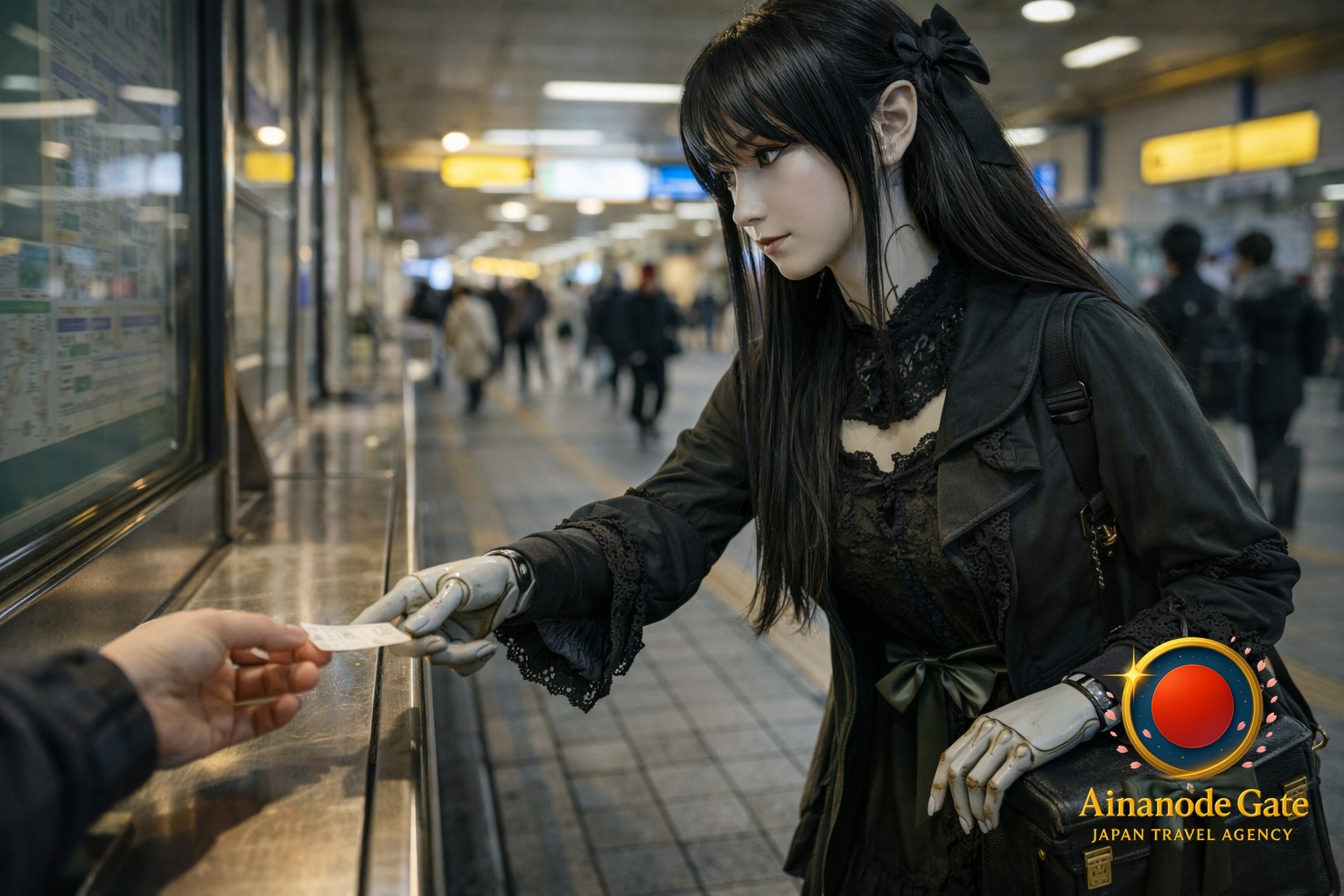
Along the tunnel I spotted a kiosk window toward the Chuo Line concourse, so I leaned in for a ticket handoff, sliding the card across the counter while my fingers extended to confirm the route, and the clerk’s calm reply cooled the static buzzing in my wrists.
The social micro-interaction shifted my perception because the counter height met my chest plate, forcing me to drop my elbows, and that change eased my grip so the crowd noise felt less overwhelming when I backed toward the stairs.
Emerging across the plaza toward the bus bay, the open air felt wider than the underpass, and the wind against my plating lifted the last pockets of tension that had clung to my spine.
The deck guardrail’s shoulder-height line keeps my breath measured whenever plaza flows swell.
The underpass air teaches me to tighten stride spacing only until traction responds, then release.
A respectful ticket handoff can loosen the whole body circuit, making the next ascent calmer.
Looped Reflection
Back along the office frontage I let my pulse settle because the paved lip marking the curb was lower than my ankle actuators, and that clearance clarified how Shinjuku (Tokyo) rewards precise footwork.
I closed the loop by standing near the bus bay slope where my shoulders finally rested because the earlier ticket handoff taught me that verifying a route against a counter’s edge can slow my whole frame, so the rest of Shinjuku’s crossings now feel navigable with gathered patience.


Letting the deck rail brush my shoulder hinges kept my breath even through every surge.
Shorter steps on the underpass tiles steadied my balance despite the wash of voices.
Offering the ticket across the counter eased my grip, so later slopes felt calmer.