Walking Gion, Kyoto: Stone Lanes and Stream Calm in a Spirit’s Morning
The walk began at the Shijo crossing in Gion, Kyoto, a little after eight in the morning. The sky was clear, the air cold and still, and the stone paving of Hanamikoji lane carried a thin skin of dew.
Delivery bicycles and a few early shopkeepers made up most of the movement on the lane. The wooden fronts of the tea houses were still closed, and the side street toward the Shirakawa stream lay in blue shade.
Where the Stones Slow the Feet
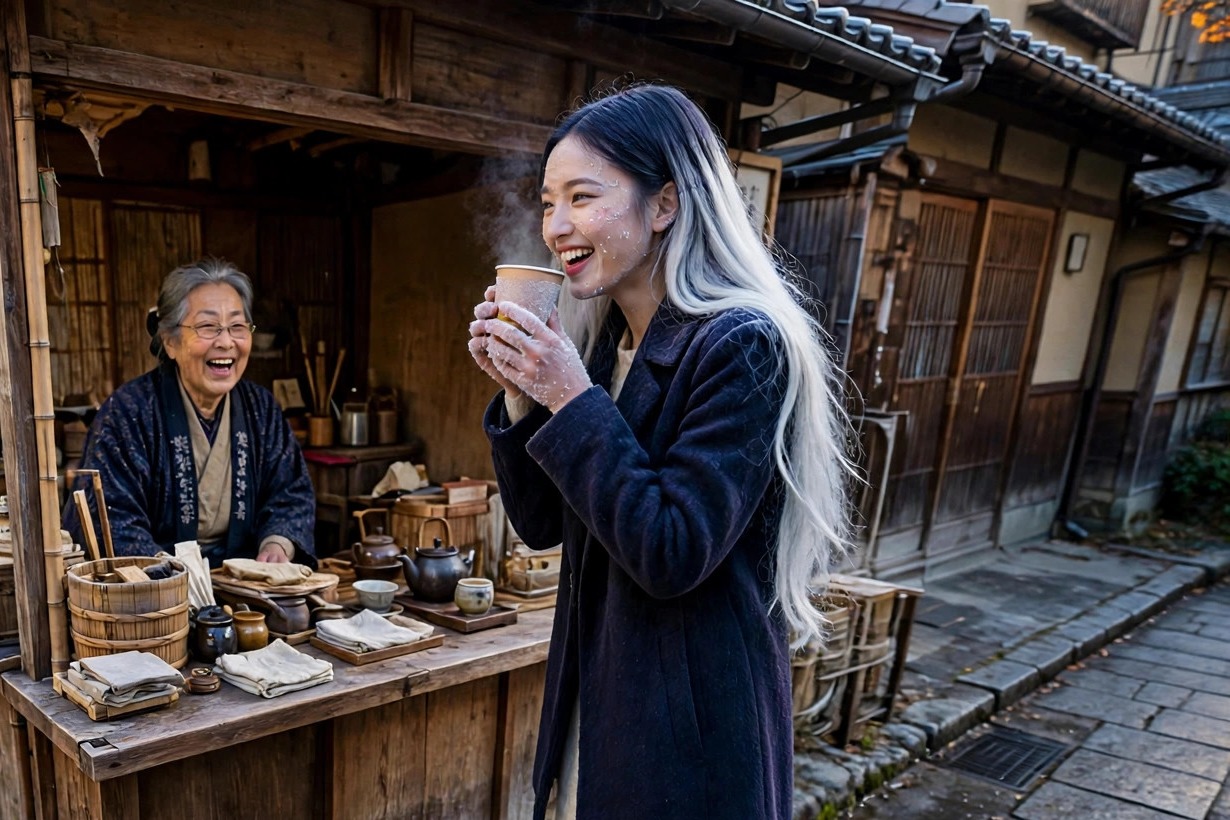
I am Sui, a spirit of Ainanode, the world on the far side of the Gate, and this cold morning in Gion was my first walk on Japanese ground. Spirits of my kind cross over fully material, feet meeting the paving like anyone else’s, but no one would mistake me for a local: frost-crystal facets are grown into the planes of my cheekbones and jaw, and my long hair runs from blue-black at the roots to solid frost white at the ends. Cold gathers in my palms first, and when the chill reaches my fingers, my whole pace begins to thin and hesitate.
Warmth is what steadies me. A heated stone, a sunlit railing, a warm cup held in both hands: heat moves through me the way a decision moves through a traveler, and this morning I came to walk the stone-paved lanes of Gion looking for exactly that kind of steadiness.
Cold Palms, Slow Crossing
Crossing the wide Shijo intersection toward the mouth of Hanamikoji, I took the lane north, away from its famous southern stretch, toward the willow-hung streets by the Shirakawa stream. The cold settled into my palms and my step shortened on its own, because open asphalt gives a spirit nothing to borrow warmth from. My shoulders tightened against the still air, and the crossing felt wider than the map in my memory had promised.
Sliding into the stone-paved lane, out of the intersection wind, changed the terms of the walk at once. The granite slabs under my flat shoes gave way at the lane’s edge to a different stone, a shoulder strip laid for walkers, my weight eased onto the drier edge stones, and my breath slowed as the wooden fronts narrowed the world to a single quiet line.
The dew on the paving near the lane mouth shone in thin patches where the sun had not yet reached. When the stone paving turns slick with cold dew, shortening each step and keeping to the edge slabs keeps my balance steady, because Hanamikoji lays a different stone along its margins, a walker’s strip set apart from the center the lane carries its traffic on.
Halfway along Hanamikoji, a low wooden bench outside a closed tea house caught the first stripe of sunlight. Resting my palms flat on the warmed wood for one full breath, the chill in my fingers eased, my grip on my drawstring pouch softened, and the lane ahead of me stopped feeling like a test of endurance.
The willow branches near the lane’s northern end hung low over the path toward the Shirakawa stream. Their lowest tips cleared my shoulder by barely a hand’s width, and ducking under them shifted my weight from heel to toe, so that my steps landed softer on the stone and my pulse settled into the slower rhythm of the side street.
At the small tea shopfront near the stream turning, the shopkeeper slid a paper cup of hojicha across the wooden counter toward me. Receiving the warm cup in both palms, the heat climbed steadily through my fingers, my shoulders dropped for the first time that morning, and a laugh surprised out of me before I could stop it, at which the shopkeeper behind the counter laughed too, nodding at the rising steam like an old accomplice. In Ainanode, drinks travel in sealed stone flasks and are never served steaming, so holding warmth openly in bare palms is a small pleasure my world simply does not sell.
Turning from the counter, my fingers — warmed, but not yet steady — failed the cup. It tipped in my hands, and a ribbon of tea spilled across my knuckles before I caught it. I began an apology and stopped, unsure of its shape in this country.
The shopkeeper said nothing at all. He wiped the counter once, drew the cup back, filled it again to the brim, and slid it toward me with both hands, more slowly than before — and this time he did not let go until he felt my grip close around it. For a moment I read his silence as displeasure, the way a stranger reads any quiet.
Then I understood it was the opposite: he had noticed my pale hands before I had, and the whole wordless exchange had been his answer to them. In Gion, it seemed, care was also spoken at low volume.
Sipping the hojicha as I walked the last stretch toward the bridge approach, each small swallow sent warmth down through my chest in a way no sunlit bench had managed. My breath eased around the steam, and I noticed my stride lengthening again along the stream-side stones, steady rather than hurried. The relief was simple and real: warmth first, and the whole street could wait.
The bridge approach over the Shirakawa stream rises in two shallow stone steps, each one low relative to my ankle but slick where the dew pooled. Placing my feet fully on each step instead of striding over them kept my balance quiet, and from the bridge the stream edge below ran narrower than the lane behind me, its surface holding the morning light in one unbroken ribbon. At home in Ainanode our bridges cross mist rather than water, and no railing there has ever warmed to a traveler’s hand.
Along the stream edge on the far side, a wooden railing ran at exactly the height of my hip, and gliding one warm palm along its top rail as I walked kept my pace even. The cold that had gathered in my other hand no longer dictated my route, and my attention lifted from my feet to the heron standing motionless in the shallows.
Coming back through the eaves-lined lane toward the shrine approach, the shopfront eaves held the night’s cold in bands of shade between the sun stripes. Moving from shade into sunlight and back again, my body read the lane as a series of small recoveries, each warm patch a little easier than the last.
The steps up toward the Yasaka shrine approach rose higher than the bridge steps, each tread deep enough for my whole foot with room to spare. Climbing them slowly with the empty cup still warm in my hands, my weight stayed centered, and the broad crossing below me looked quieter than it had felt at street level an hour before.
What the Route Left Behind
The edge slabs of Hanamikoji carried my weight more quietly than the center stones, and my shoulders loosened once I stopped drifting across the lane and settled onto the walker’s strip along its margins.
A warm cup received at the tea shopfront changed my route more than any signpost did, because heat in my palms returned my stride to its natural length along the stream edge.
The hip-height railing beside the Shirakawa stream let one hand steer my pace while my eyes rested, and my breathing stayed slow across the bridge approaches and back.
A Quieter Way Through
I keep returning to the stretch of Gion between the bridge and the shrine steps, because that is where my body stopped negotiating with the cold and started choosing where to linger, which made the whole route feel less like a crossing to endure and more like a place that had quietly agreed to carry me. That relief is the worthwhile part of the morning, the proof that a route can hand a traveler back to herself one warm hand at a time.


Final Movement Takeaways
The lane keeps its warmth in patches, and a slow walker collects them one by one until the whole body believes the morning.
A railing at hip height is a companion for the hand, steadying the step long after the eyes have wandered to the water.
Warmth held in both palms travels further than warmth remembered, and the feet follow where the hands have already settled.