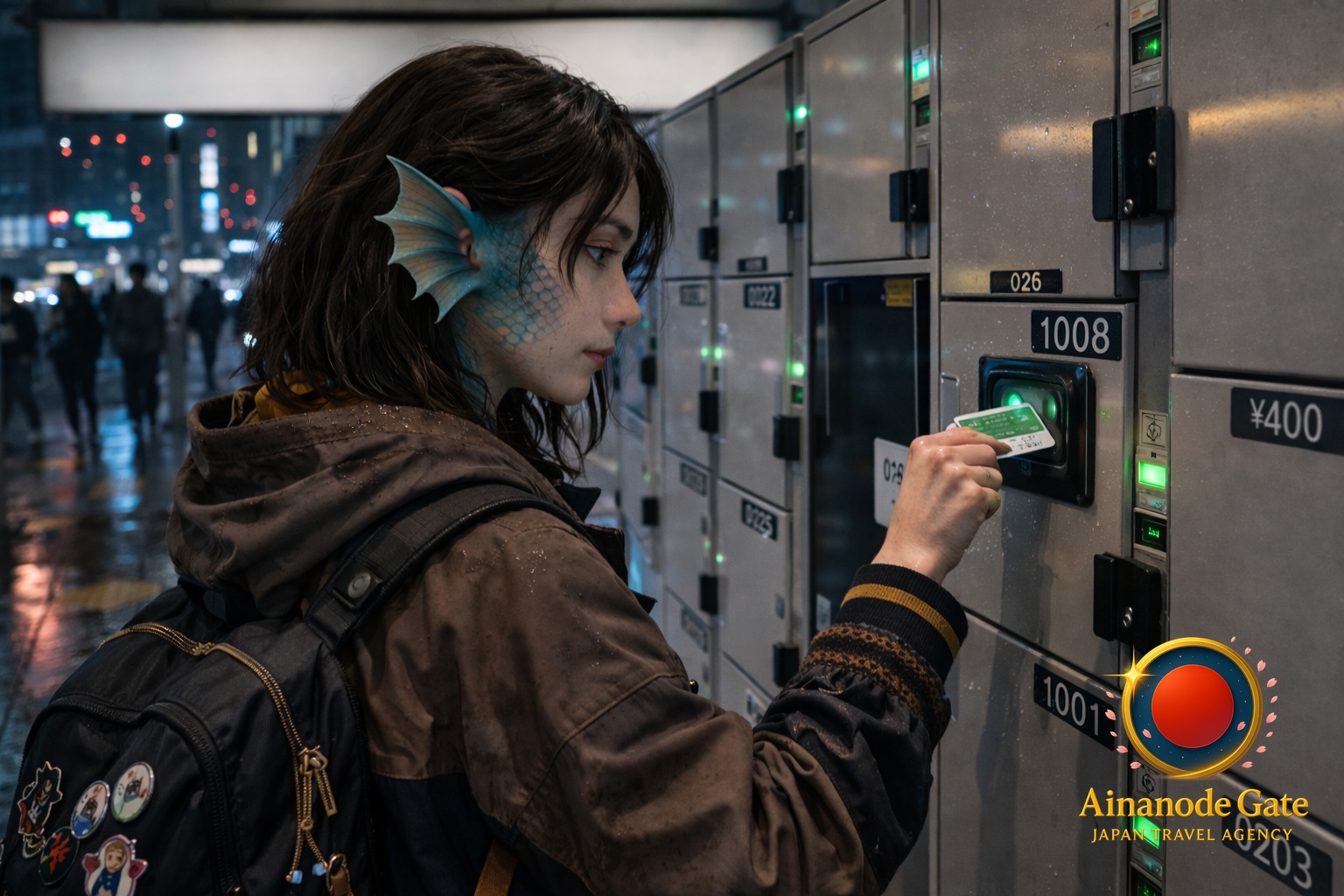
Cloud-Soft Locker Drift in Ginza
Ginza, Tokyo, 20:10, cloudy ceiling, dry marine breeze.
Moderate foot traffic at Ginza Station exits spreads evenly along the sidewalk line.
Neon Drift Against Clouded Chrome
Kaia, a night-oriented merfolk guest, keeps her lateral lines alert in the Ginza Station concourse where recycled air cools her gills and steadies her breath before she meets the street.
Her moisture-lined jacket glides over scaled shoulders so the exterior storefront line of Ginza feels less abrasive when crowds tighten and then loosen with each signal cycle.
Shoulderline Notes on Chuo-dori

The breath-coded signage of Ginza Station Exit A4 slid behind me as I rose from the tiled ramp toward the main sidewalk, and my shoulders eased while the night breeze traced the seam of my neck fins.
Inside the adjoining Ginza Station coin locker bay, I pinned my satchel with my hip, felt my wrist tighten, and turned the coin locker key with a careful twist until the door’s lip skimmed the edge of my gill line, which softened my pulse once it clicked open.
Stepping from the concourse into the broad Ginza sidewalk, my stride shortened along the storefront line and the weight in my calves lightened as the cloudy glow diffused against glass facades.
I moved toward the Ginza 4-chome intersection and felt my balance tighten because the crosswalk stripes reflected the overcast light, so I let my tail-root muscles guide the pacing.
When the granite sidewalk turns slick under the thin mist along Chuo-dori, adjusting my footfall to shorter diagonal steps keeps my core steady as I cross the curb lip toward the median.
As a Merfolk, I chose the outer edge instead of the inner lane and adjusted my pace along the Ginza storefront awnings so the drier overhang let my breath slow while neon flares stayed outside my peripheral floodlines.
I slipped from the main avenue toward the narrower backstreet behind Ginza Six, and the quieter than plaza-grade murmur let the tension in my ribs drop as delivery vans hummed at ankle height compared to the bus traffic.
The brushed-aluminum handrail sat just below my shoulder ridge, and aligning my spine with it steadied my balance while I traced along the brick verge that runs parallel to the service doors.
Back through the cross-lane arcade, my breath lifted because the narrower roofline filtered the cloud glare, and I could feel the humidity bead along my temple fins in softer pulses.
I angled along the station-bound sidewalk edge where crowd spacing was less than the center lane, letting my grip on the satchel loosen as the traffic noise damped against the granite planters.
Crossing toward the Yurakucho side, I felt my chest ease since the street was wider than the backstreet and the wind tunneled along the buildings, guiding my balance toward the station entrance.
I left the Ginza Station plaza satisfied because following the quieter storefront edge eased my pulse and taught me how the cloudy night can still soften my land steps.
Movement Echoes After Rain
The coin locker pause near Exit A4 left a steadying echo in Kaia’s wrist, reminding her that small, deliberate resistance can loosen a whole shoulderline before facing the neon stretch.
Backstreet breaths arrived slower because the service-lane hush let her compare lane widths, reinforcing that edging along sheltered storefront seams alters pulse more than chasing the center stream.
Ren’s Summary
Ren sees how Kaia let the cloudy Ginza grid teach her that a merfolk body can soften even without water when each transition—locker bay, avenue, backstreet—becomes a measured shift in breath and balance.

The locker click taught me that resistance can melt the shoulders before neon pressure builds.
The slick granite along Chuo-dori now feels manageable because diagonal steps cradle my balance.
The backstreet hush showed me that quieter-than avenues still feed the pulse back into the station flow.