Ground-Level Breath along Tokyo Station Edges
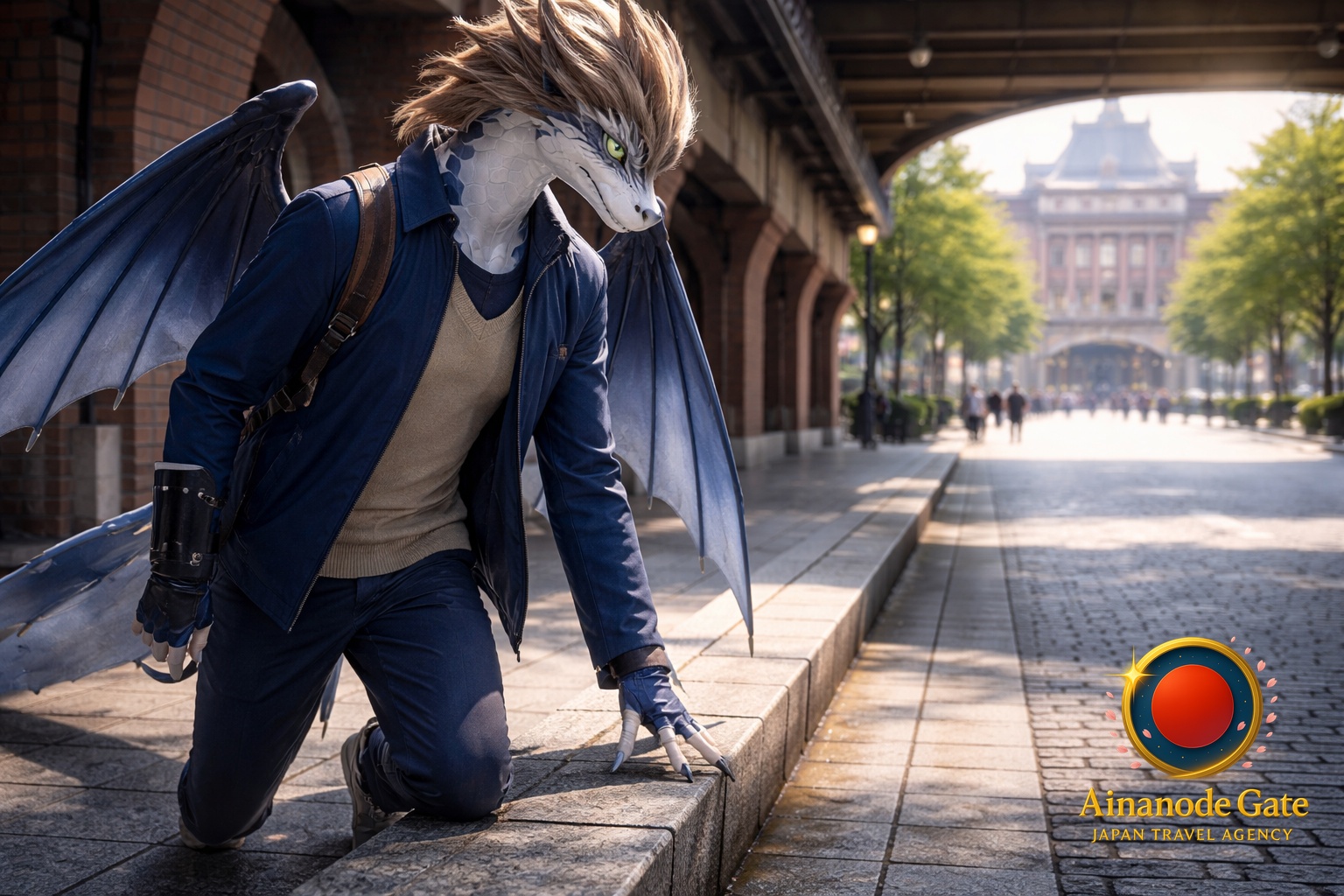
Tokyo Station Marunouchi frontage at 09:10 with clear March light and moderate commuter flow.
Under-Track Morning Current
Kiyo the Wa-Dragon arrives lean and curious, her scale plates tuned to the faint tremor of every granite seam that flanks the station frontage.
Flexible mid-body plating and patient focus let her test each curb edge without rushing the people beside her.
Street-Level Circulation
My breath steadied along Tokyo Station’s Marunouchi station frontage as granite coolness lifted the tension from my forearms while taxis stacked wider than the inner curb.
I moved from the bright frontage toward the under-track passage beneath the Chuo Line, and my shoulders lowered when the compressed roof filtered light into soft strips that shifted my attention to each claw placement.
Crossing Sotobori-dori toward the Yaesu side tightened my balance because signal cycles stayed brief, yet easing my tail low let each step stay quieter than the bus queue edging the curb.
Along the side street beside the Yaesu underground bus ramp, my stride length matched the curb lip, and the brush of my shoulder fin against the waist-high guardrail softened the lingering chill into alert alignment.
When the Yaesu underpass floor holds last night’s condensation, adjusting my heel-to-claw rhythm into shorter placements results in a steadier pulse because the slick tiles stop yanking at my hips.
I curved along the Nihonbashi River guardrail where the air smelled metallic, and the width felt less than the station frontage so my lungs slowed to match the narrower wind channel.
As a Wa-Dragon, I chose the shaded curb edge along the riverside pocket park and adjusted my pace so the scale plates around my ankles could cool, which lifted my curiosity into an easy hum.
Back through Tokyo’s under-track corridor toward Marunouchi, my chest expanded as the floor lamps sequenced ahead, and the route felt calmer than the outbound push so my shoulders eased even while footsteps echoed.
I pivoted along the plaza edge by Gyoko-dori avenue, feeling the crowd spacing loosen until my weight settled downward, and that relief felt valuable because the open curb let me keep scanning tiles instead of dodging elbows.
The Marunouchi frontage gifted a broad inhale, yet the moment the ceiling lowered under the tracks, the body answered by softening the shoulders and letting the eyes track tile seams instead of skyline glass.
Riverside air cooled the ankle plates more efficiently than the covered corridor, so the return through the same tunnel carried less urgency and more trust in each curb edge.
Ren’s Summary
I watched Kiyo learn that Tokyo’s ordinary links—station frontage, underpass, riverside guardrail—can tune a dragon’s breathing simply by alternating compression and release along the route.
I left Tokyo’s Gyoko-dori edge feeling newly attuned because the detour through the under-track corridor slowed my breath enough to read how the paving drifts under my claws.


Granite seams keep the pulse steady when I match breath to their cool weight.
Under-track ceilings ask for lowered shoulders, rewarding the shift with calmer steps.
Riverside guardrails lend narrow focus that I can bring back to the wide plazas.