The Land Beyond the Gate
Every traveler who appears in Traveler’s Voice came from somewhere.
They stepped through the Ainanode Gate — scholars, spirits, beastfolk, automata, creatures shaped by laws that do not hold on this side — and arrived in Japan with their own weather still on their shoulders. This site has recorded where they went: the stone lanes of Gion, the counters of Nishiki Market, the hush of a shrine in the early morning.
This column looks in the other direction.
Beyond the Gate is the agency’s record of Ainanode itself: the world our travelers call home. It is not escapism. It is the other half of every journey we publish — because to understand why a spirit lingers in a Kyoto lane, it helps to know what lanes look like where she comes from.
A World of Many Peoples
Ainanode is not one country, and its people are not one kind.
In the high, quiet places, one may encounter communities of spirits. Some of Ainanode’s busiest market towns were raised by beastfolk. Among its automata are those who still follow routines inherited from earlier ages. Kitsune can be found carrying messages between settlements, while merfolk tend waterways and dragonkin maintain some of the old roads. Elves, dwarves, oni, halflings, dryads, and a dozen peoples besides share borders, festivals, and arguments that have been running for centuries.
They do not share biology. They do not share origin. Some do not even live by the same physical laws.
What they share is practice. Ainanode is an old world, and over a very long time its peoples have learned the difficult art of standing beside difference without sanding it down. There may be something familiar in that. It is a quality our travelers sometimes recognize — with a start of surprise — in their encounters in Japan.
The Gate
In Ainanode’s records, the Gate is often depicted at the seam between worlds.
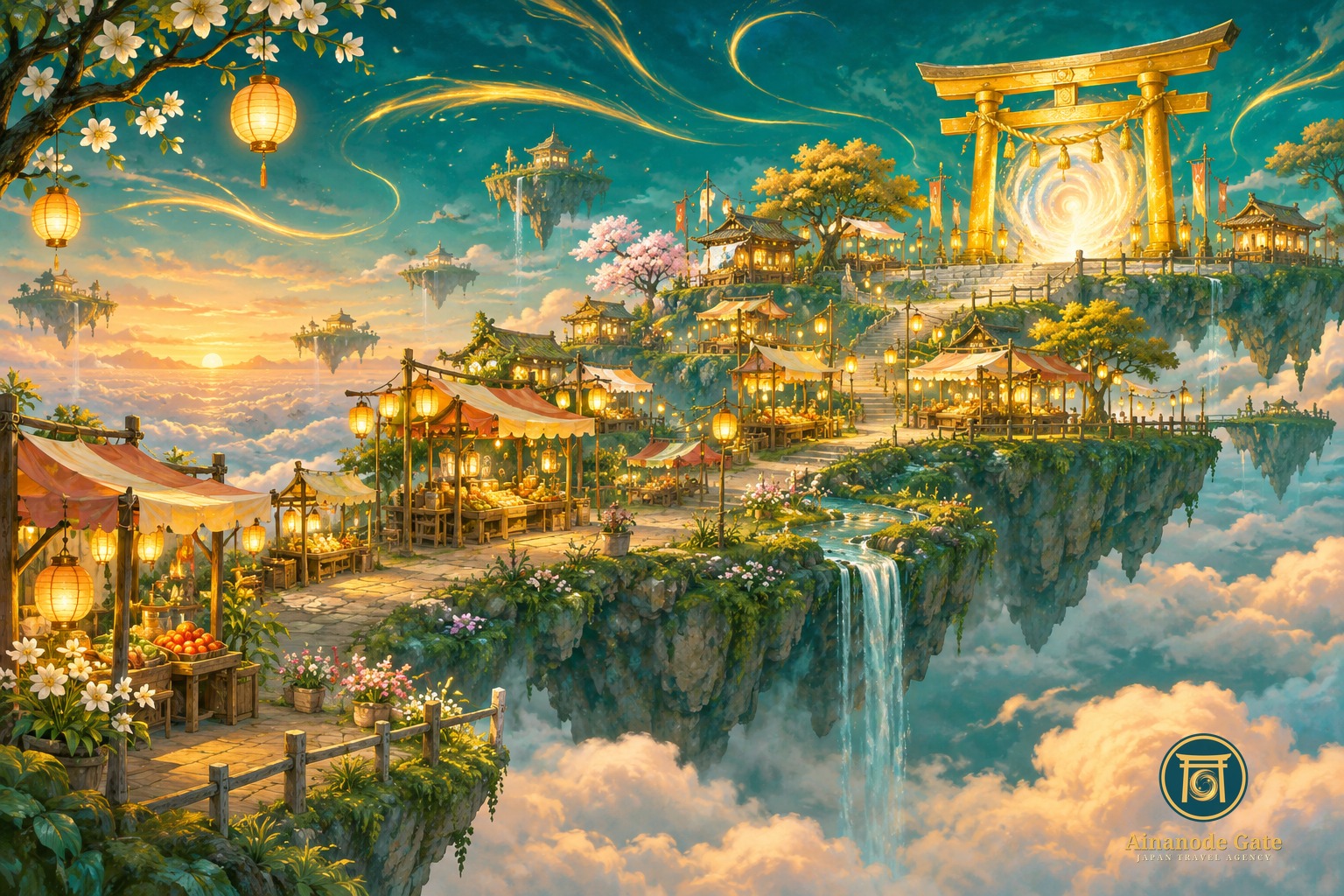
One familiar depiction shows a great torii of gold-lit wood and stone, raised above the lantern terraces, with floating islands turning slowly beyond it. Crossing is not a commute. It is a journey, undertaken deliberately, with the care that a meaningful journey deserves: with preparations, with gifts for hosts, and with the understanding that no meaningful journey leaves a traveler entirely unchanged.
On the Japan side, the crossing is quieter — a traveler simply arrives, blinking, in a country where everyday life is shaped by both written rules and social conventions that may be unfamiliar to newcomers. That is why the agency exists. We stand at the seam in both directions: preparing Ainanode’s travelers for Japan, and preparing Japan’s readers, gently, for Ainanode.
Fragments of Daily Life
A few notes, gathered from the agency’s records, for readers meeting this world for the first time.
The lantern terraces. Many of Ainanode’s towns climb. Streets are terraces, and lanterns line the terraces — not for decoration, but because the mists arrive quickly at altitude, and a lit lane is a promise that someone is keeping watch. Travelers from Ainanode photograph Kyoto’s lanterns with an emotion Japanese readers may find familiar: homesickness.
Markets. In some Ainanode towns, markets open when the first stall is ready, and not a bell earlier. Haggling is considered a form of conversation; to accept the first price too quickly can read as refusing to talk. For travelers accustomed to such markets, Nishiki Market offers a curious contrast: familiar aromas, lively counters, and prices that are generally fixed. Even familiar places can teach unfamiliar customs.
Greetings. Across Ainanode, no single form of greeting is universally observed. What matters is not the form but the pause before it — one breath in which you actually look at who is in front of you. Some of our travelers have found something familiar in the small pauses that accompany greetings and everyday encounters in Japan.
Why They Come to Japan
Not for novelty. Ainanode has no shortage of wonders.
Many come to Japan out of curiosity. Some discover moments that remind them of something Ainanode has spent centuries learning: how different ways of life might stand beside one another without losing their identities. An old shrine beside a modern railway station. A centuries-old festival unfolding along streets lined with contemporary buildings. Crowded cities that still function through subtle, mutual awareness.
Our travelers recognize it the way you recognize a song in a language you do not speak.
And so they walk. Through Gion at dawn, through Osaka at full volume, through markets and shrine gates and escalator debates — and each journey narrows, a little, the distance between their world and this one. Those journeys are Traveler’s Voice. This column is where the travelers come from.
Summary
Beyond the Gate documents Ainanode itself — the world on the other side of the Gate, home to every traveler in Traveler’s Voice. A land of many peoples and floating isles, of lantern terraces and unhurried markets, whose oldest art is coexistence. New fragments will be added as the agency’s records grow. The Gate is symbolic. The journey, on both sides, is real.