Nishiki Market, Kyoto: A Halfling Tastes Kyoto’s Kitchen
Nishiki Market runs along Nishikikoji Street in central Kyoto, one street north of Shijo, from Teramachi in the east to Takakura in the west. The covered lane is about 390 meters long and 3.3 meters wide, lined with some 130 food shops.
It is just after ten on a clear late-November morning. The air under the arcade roof is cool, the last shutters are going up, and the lane is beginning to fill.
A Lane Three Meters Wide and Four Hundred Years Deep
I am Pim, a halfling, and I crossed the Gate from Ainanode because Ren promised me a street that cooks for a whole city. At home our market stalls sing their recipes aloud, and a dish nobody can sing is a dish nobody buys. Nothing sings here.
The smells do it instead, one shop at a time, and at my height they arrive early. I stand barely a meter tall, which in this lane means the counters reach my chin and every tray travels at the height of my nose. Ren says a kitchen should be read with the whole body, and mine had no choice.
Steam at Chin Height


I came from the bright crossing at the west end into the covered lane, and the light dropped a step as the roof took over. My shoulders eased down with it, and my breathing slowed to the pace of the shutters still rattling up along both walls.
The lane is narrower than the shopping street outside, yet at my height it reads wider than the market square at home, because everything in it is stacked at eye level. My grip on the basket tightened where elbows and shopping bags crossed at the height of my face, then loosened again once I settled along the shopfront edge, where the flow ran thinner that morning.
Steam found me before sight did. A pan of dashimaki was breathing somewhere ahead, and the warm dashi air met my cheeks at tray height, softer than the cool arcade air behind it, so my steps shortened and my chin lifted toward the smell without asking my feet.
Eating Standing Still
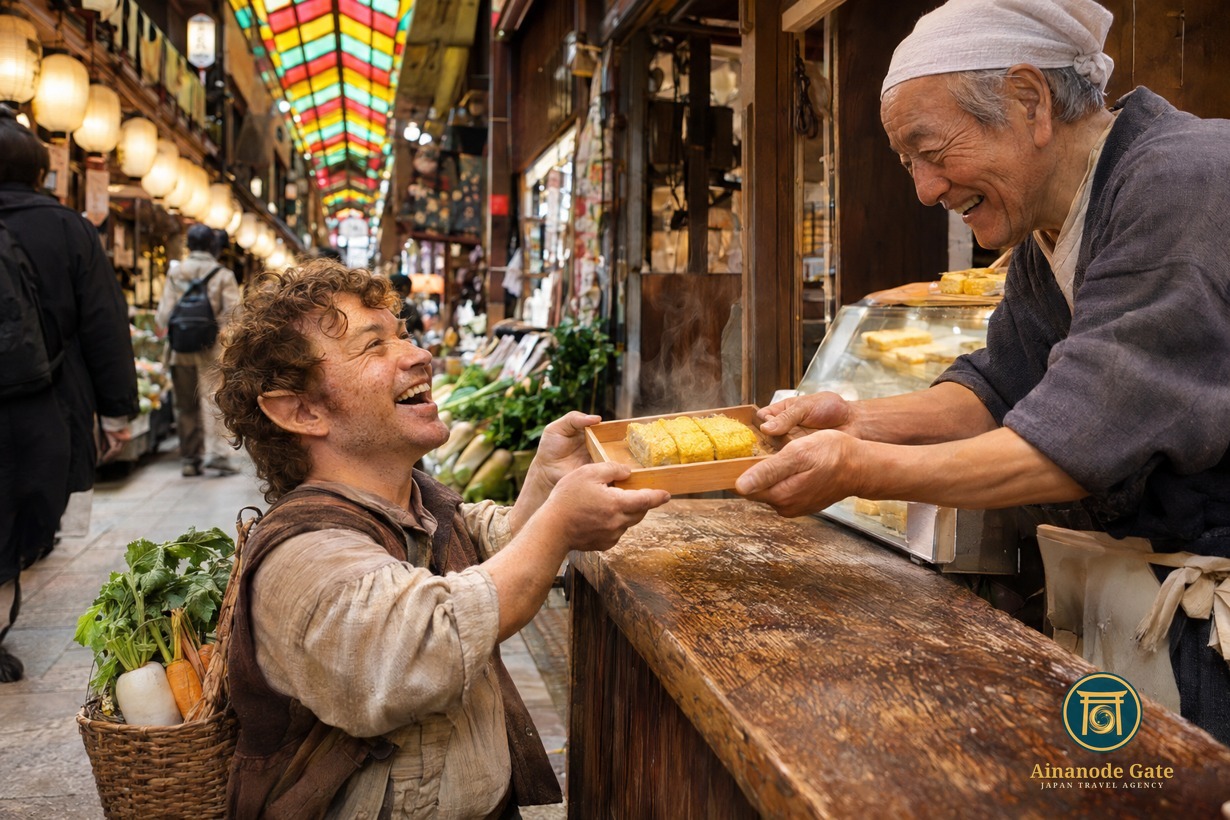
At Miki Keiran, the dashimaki shop marked on the market’s own map, the counter stood level with my chin, and the shopkeeper slid a small wooden tray toward me across it. I received the warm slice with both palms, the tray’s edge steady against my hands, and the steam curled up past my face and loosened the tension in my jaw before the first bite.
He laughed when he saw my height, not unkindly, and moved my tray down to the low shelf at the counter’s end, where I could eat standing in the shopfront’s own space, out of the walking flow. The egg was soft and sweet with dashi, and my shoulders dropped another finger’s width as the warmth reached my chest.
The first bite folded apart in layers, warm all the way through, dashi first and then a gentle sweetness, softer on my tongue than any egg at home, where eggs are sung about but seldom taste like this. I laughed out loud with my mouth full, which is poor manners in two worlds, and the shopkeeper laughed with me and tapped the tray twice, pleased, while my cheeks warmed with more than steam.
Standing there, I understood the request in my body instead of my head. When the lane fills and a tray passes at face height, one careless turn can paint a stranger’s coat with your lunch, so stepping into the shopfront space to eat keeps both the food and the crowd safe. Around me, Kyoto grandmothers were doing exactly the same, finishing each bite where it was bought and handing the tray back over the counter.
Two doors along, a pickle shop offered tasting sticks of kyo-tsukemono from a chilled case, and the first sour bite sharpened my breath and straightened my back. The shopkeeper’s wife set a second taste beside it without being asked, and the weight of my basket shifted as she added a small wrapped parcel to it, so I changed arms and felt my balance settle on the other side.
The Lane Fills Toward Noon
Toward noon the delivery carts were gone and the tour groups arrived, and at my height the lane became a slow forest of coats, quieter than the open crossing behind me yet denser at every step. My stride shortened to half its morning length, my basket pulled close against my ribs, and the small tension in my neck eased each time I slipped along the edge past a knot of people stopped at a fish stall.
At the cross streets the flow thinned for a breath, then closed again. I learned to read the lane the way I read weather at home, moving in the lulls and resting in the shopfronts, and my pulse stayed steadier than it had in the first crowded stretch, when I had tried to keep my morning pace.
Then the roof ended. I walked out of the covered lane into the open air at the Teramachi end, where the small shrine of Nishiki Tenmangu stands across the way, and the light widened all at once. My chest opened with it, the market’s noise fell behind my shoulders, and my steps lengthened back into their own rhythm on the open pavement.
I stood at the east end of Nishiki with a full basket and dashi still warm somewhere under my ribs, and I judged the lane the finest kitchen I have ever walked, because it fed me the way it feeds its own city: one counter at a time, eaten standing still, which made a halfling’s smallness stop being a problem and start being the exact right height for tasting.
What the Route Left Behind
The shopfront edge carried me more easily than the center of the lane had that morning, and my shoulders loosened once I stopped fighting the flow and let the thinner stream along the counters set my pace.
Steam arriving at face height before my eyes found the shop reordered my walking, because a smell at tray level slowed my steps and lifted my chin sooner than any signboard could.
Eating standing still in the shopfront’s space turned the market’s request into a rest, and my breathing stayed slow long after the tray went back over the counter.
What the Kitchen Recorded
Ren, closing the record: Nishiki has fed Kyoto for about four hundred years, and it still works the way Pim’s body learned it. For the record, then: the shops keep their own hours, most opening by ten and many resting on Wednesdays. Pim found the lane gentler shortly after his arrival than it became toward noon.
The association asks that food be eaten where it is bought, at the counter or inside the shop, and the tray goes back to the same hands that filled it. And when the lane fills toward noon, its edges carried a small walker more kindly than its center did.


Final Movement Takeaways
Where the flow was thinner along the shopfronts that morning, Pim found the narrow lane easier to navigate, and his shoulders felt the difference first.
Warmth received in both palms at a counter travels down into the feet, and the whole body slows to the temperature of the food.
A request about standing still, understood at face height, becomes a place to rest inside a crowded street.